Serene Safety has joined the Norfolk Chambers of Commerce to raise the profile of the business in and around East Anglia and our home county of Norfolk.
Norfolk Chambers offers a range of benefits that will help and promote the Serene Safety brand and allow us to share our ethos on safety and health obligations that Norfolk businesses have.
Jonathan Reynolds, Serene Safety’s Principal Consultant and Tutor said
‘Joining the Norfolk Chambers was our next step in promoting our brand and affiliating with a group that has a long heritage and allows the voice of small business to be heard and considered. Serene Safety has sustainable plans for growth and equally wants our clients to grow with us on this journey – We are confident that the mutual help and support we will provide each other will benefit businesses in Norfolk.’
‘Target Zero’, ‘Club Zero’ or just ‘Zero’…… The premise takes many names but ultimately drives the concept of a workplace which has no adverse events that result in an injury, loss of life or damage to assets. I can absolutely get behind the goal and it is the driving force behind many safety and health professionals the world over. But is it achievable or simply a utopian phrase where the meaning isn’t truly realised?
As with most of our blogs we pose a number of questions to allow our readers an opportunity of reflection and thought provocation with this topic generally being both emotive and analytical.
Benchmarking
In my opinion, the ‘zero’ concept is noble, just and right – Everyone can get behind it, can’t they but is it realistic? That depends on a number of factors.
These factors can be, but are no means exhaustive:
Current incident performance – No incidents, a few minor first aid cases, a lost-time injury or reportable injury, permanent disability or multiple fatalities – We need an initial baseline on which to identify the standard we want to set.
Current safety climate – Are standards high, low, indifferent? Is the business pristine all of the time or just when it counts?
Current safety culture within the organisation – How are things done within the organisation, how does it tick and, more importantly, what do the workforce perceive to be the goals of the business and expectations on how they are achieved?
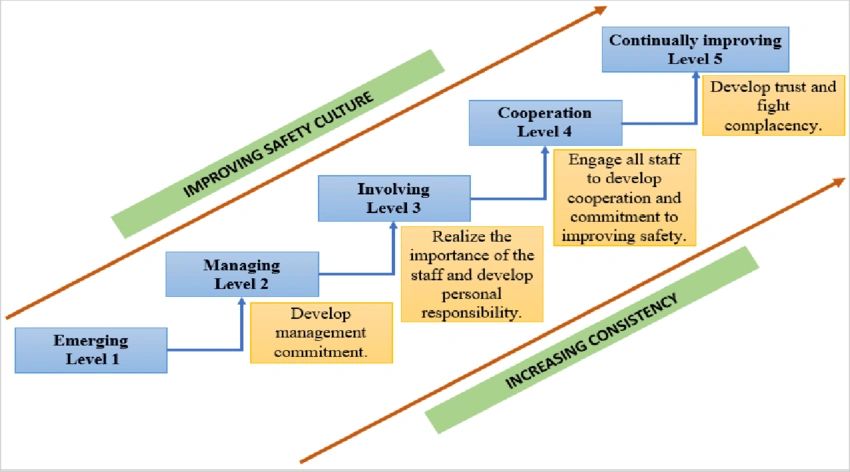
Flemings Safety Culture Maturity Model
Cultural maturity of the organisation – What stage is the organisation at when we look at it’s cultural maturity. There are many models out there as organisational culture has been debated over many years.
Reporting history and maturity – How do the organisation report incidents? Are they encourage, discouraged, expected, avoided.
Leadership – Where does the leadership team cast their shadow? Are their teams health, wellbeing and safety on their agenda? Is it considered, an afterthought or non-existent.
Investment into safety and health – Do safety and health related improvements feature within the development plans of the organisation, does it receive any capital expenditure, is safety and the health of employees considered during the capital allocation of monies to projects to ensure steps are taken to ensure people are safe and risk has been designed out or is it an afterthought?
Industry – Is the organisation operating within an industry that has high expectations on it’s safety and health record and performance or is it a sector norm that standards are historically low.
Legislative environment – Does the organisation operate in a highly regulated environment or operating in parts of the world where safety legislation is still developing?
and many more but this all factors into the organisations ability and credibility in whether or not zero incidents and injuries is realistically achievable.
With the above reviewed, analysed and a certain degree of understaning of where an organisation is ‘today’ we can begin to look at how realistic the ‘zero’ concept is.
Knowing Where You Are Going by Where You Have Been
The next stage is very much time to look at where we want to be. Not only ‘what does good look like?’ but ‘what does ‘our’ good look like?’ or ‘what does ‘our’ good need to look like?’ to grow towards the target of ‘zero’. What good looks like needs to come from the organisation.
Once ‘good’ has been established in the horizon, you need to get there. Factoring in all the measures, metrics and outputs from the reflection of ‘where we have been’. This may well be a three, five or ten year plan however it will be each to their own and depend, largely, on the factors discussed above that dictates how much pace is behind the plan – Now, you could change that, however, that’s an entirely different blog discussion.
Target Zero or Not
With all that said and done. With all (or as much as you can muster) the information available to you, is ‘zero’ viable? is it achievable? Is it the right thing to do for the organisation?
Let me pose some questions:
Is having a zero target meaningful to an organisation of 10 people with a poor safety performance?
Is having a zero target meaningful to an organisation of 100 people with a poor safety performance who have had a fatal incident?
Is having a zero target meaningful to an organisation of 1000 people with a poor safety performance who have had 10 fatal incidents?
Is having a target to reduce fatal incidents by 3 each year meaningful to an organisation of 1000 people with an improving safety performance who have had 10 fatal incidents previously?
Is it unjust or immoral as it would appear an organisation is happy to sustain 7 fatalities however pat themselves on the back because they reduced it by 3?
Would the families of those theoretical 7 people take comfort that 3 other families still have their loved one home each night whereas they still retain the empty void of where that loved one once was? What about the 4 the year after or the 1 the year after that?
Alternatively if we looked through another lens:
Is having a zero target meaningful to an organisation of 10 people with a good to excellent safety performance? – I’d say so.
Is having a zero target meaningful to an organisation of 100 people with a good to excellent safety performance? – I’d say so.
Is having a zero target meaningful to an organisation of 1000 people with a good to excellent safety performance? – I’d say so.
Would you? – We have another blog in development to counteract this looking into leading indicators and positively focused indicators to prevent the lagging ones altogether.
We’ve discussed a lot there and it’s given me a lot to reflect on to which I hope it has had the same impact on you and I’d love to keep the conversation going – Our social networks are a great place to debate this topic and others.
We have facilitated a number of benchmarking, mapping and profiling sessions with clients across a range of topics and we would love the opportunity to support you on your journey be it developing your culture, risk profile or strategic and tactical direction.
HMRC ‘nudge letters’ – what are they, why do HMRC issue them, and what should you do if you receive one? Tax experts Gilly McGill and Dominic Carter discuss what the term covers – commonly known as ‘one-to-many letters’ and how HMRC identify recipients through data submitted to them or issues common to a sector. They discuss how the decline in human resourcing to investigate impacts this process.
They provide recent examples of problems HMRC have faced and the potential penalties that may come from ignoring these letters, and how your adviser can help.
For further information on today’s topic, and how we can help support you and your business on all tax related matters, click here.
You can get in touch with our presenters directly through the Our People section of our website here.
GET IN TOUCH! If you have any questions on today’s episode, and would like us to get in touch, email us at [email protected].
We would also love it if you could rate us 5 STARS on Apple Podcasts or Spotify, this really helps people find us!
With Gen Z now entering the workforce, how do you go about navigating the massive cultural divide that might now exist in your office and create a balanced workplace culture?
Typically, Gen-Z are no wallflowers; strong minded, often politically active and not afraid to call out inappropriate ‘banter’. They are moving into workspaces with Gen-X, millennials and even boomers, who have not had to deal with such a big cultural leap in the generational divide for some time.
How you operate on a day-to-day basis may start to look different, not necessarily for better or worse, just different. Mark and Becky troubleshoot what leaders could face and how they would handle different opinions and create a safe culture and boundaries for everyone.
GET IN TOUCH! We would love to hear your thoughts on today’s episode, email us at [email protected]
We would also love it if you could rate us 5 STARS on Apple Podcasts or Spotify, this really helps people find us!